The house of the deaf man
In February 1819, Francisco de Goya bought a farmhouse on the far bank of the Manzanares river, outside Madrid. He was seventy-two, the most celebrated painter in Spain, and almost completely deaf after an illness in his forties had taken his hearing. The house was already known as the Quinta del Sordo, the House of the Deaf Man, after a previous owner who had also been deaf. It was a coincidence Goya must have appreciated.
Spain around him was sliding back into repression. He had survived plague, war, the Inquisition's attention and two near-fatal illnesses. He lived there with his companion Leocadia Weiss, and over the next four years, working in oils directly onto the plaster, he covered the walls of two rooms with fourteen paintings that no one had commissioned and no one was expected to see.
Something to look at while you eat
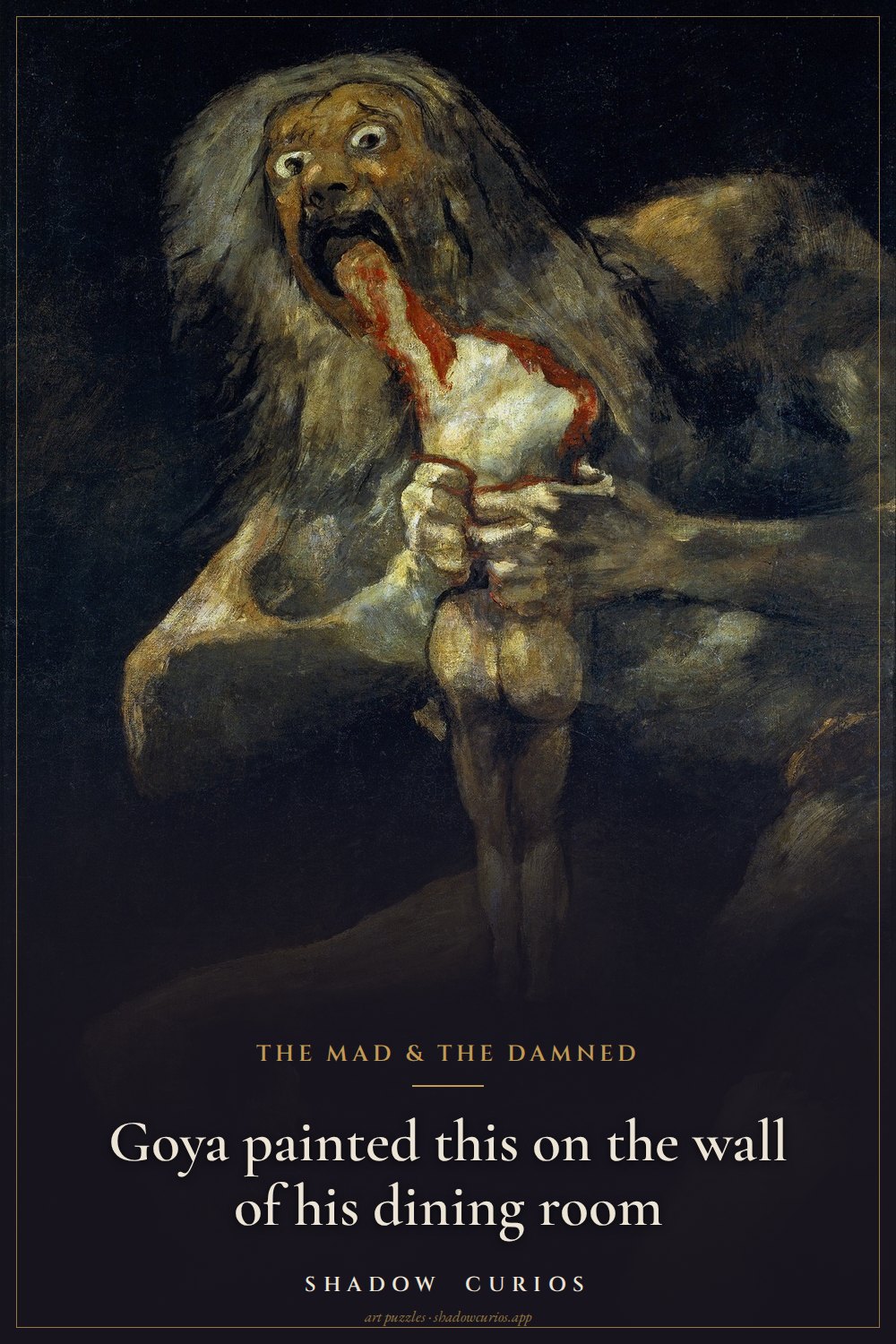
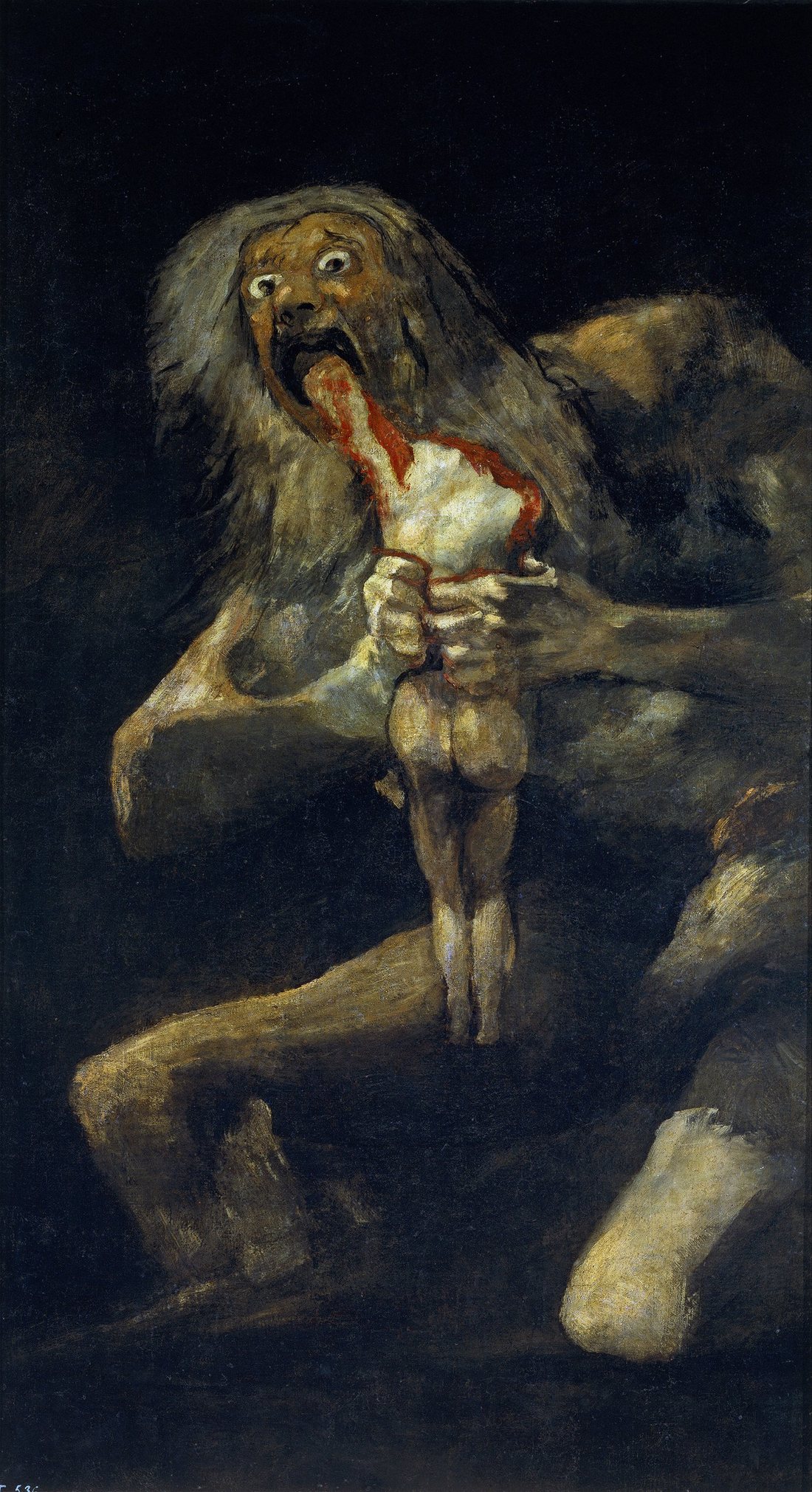
Saturn was painted on a wall of the ground-floor dining room. In the myth, the god Saturn was warned that one of his children would overthrow him, so he swallowed each one at birth. Rubens had painted the scene two centuries earlier as a grim, bearded god, calm and deliberate, going about his work.
Goya's Saturn is not calm. He comes lurching out of the dark, grey hair streaming, eyes stretched so wide the whites show all round. The child in his hands is no longer a child but a pale, full-grown body. The head is already gone, and he is tearing into an arm. What makes the painting so hard to look at is the face. Saturn does not look hungry. He looks terrified, as if he cannot stop, and knows it.
No title, no explanation
Goya never titled the Black Paintings, never wrote about them, and never explained them. Every name they carry was given by other people after his death. Whether Saturn is Spain devouring its own people, time devouring everything, or an old man's terror of his own mind, Goya left no answer. He left Spain for exile in Bordeaux in 1824, and died there in 1828.
Cut from the walls
For half a century the paintings stayed where he left them, slowly flaking. In 1874 a French banker, Baron Frédéric Émile d'Erlanger, bought the house and had the Prado's chief restorer, Salvador Martínez Cubells, peel the murals from the plaster and transfer them to canvas. It saved them, at a cost: the transfer damaged the paint, and restorers smoothed over what was lost. Scholars have claimed the mural originally showed Saturn more graphically, in a detail removed in the process.
The Baron showed them at the Paris World's Fair of 1878, where almost no one paid attention, and in 1881 gave them to the Spanish state. Today they hang together in a dim room of the Prado, and Saturn is the one people stop in front of, and can't quite walk away from.