A father's blow
Ivan IV was not called Terrible for nothing. He built a private army of black-robed horsemen, the oprichniki, who rode with dogs' heads and brooms tied to their saddles to sniff out and sweep away traitors. In 1570 he turned them loose on the city of Novgorod, and thousands died. By 1581, few men in Russia dared contradict him.
His eldest son did. That November, at the royal retreat of Alexandrova Sloboda, the tsar found his pregnant daughter-in-law resting in her underclothes, a breach of court propriety, and beat her. She lost the child. When the young Tsarevich Ivan confronted his father, the tsar struck him on the head with the iron-tipped staff he always carried. The heir lingered for days and died on 19 November. Ivan is said to have spent the nights that followed howling in grief.
With his capable son gone, the throne passed to a weaker one, and the dynasty ended in the chaos Russians still call the Time of Troubles.
Blood in the air
Three centuries later, the painter Ilya Repin could not get the story out of his head. The year 1881 had soaked Russia in blood: Tsar Alexander II was assassinated by a bomb, and Repin watched his killers hanged in public. That same year he heard Rimsky-Korsakov's symphony Antar, whose second movement is called Vengeance, and he later said the music gave him the picture.
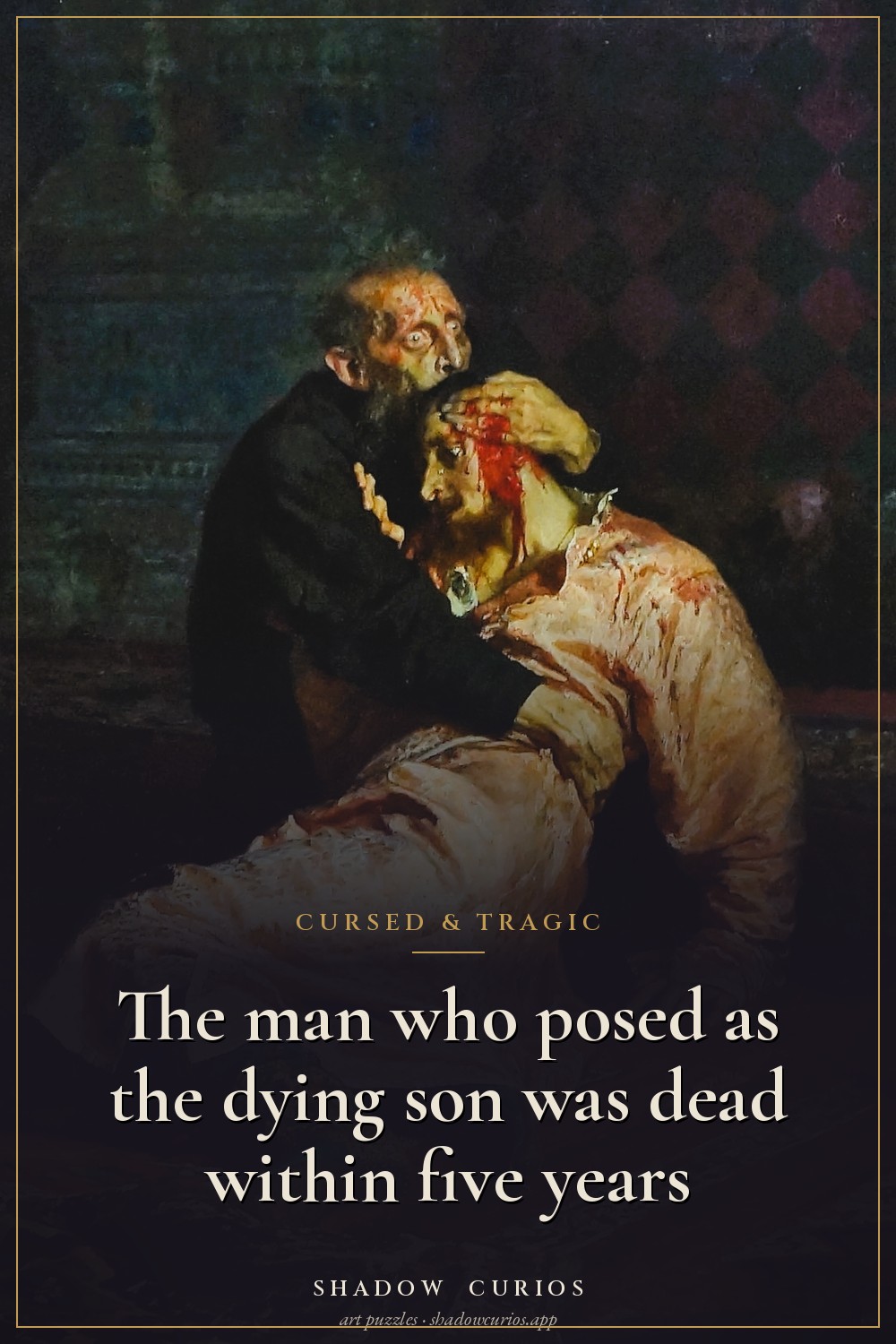
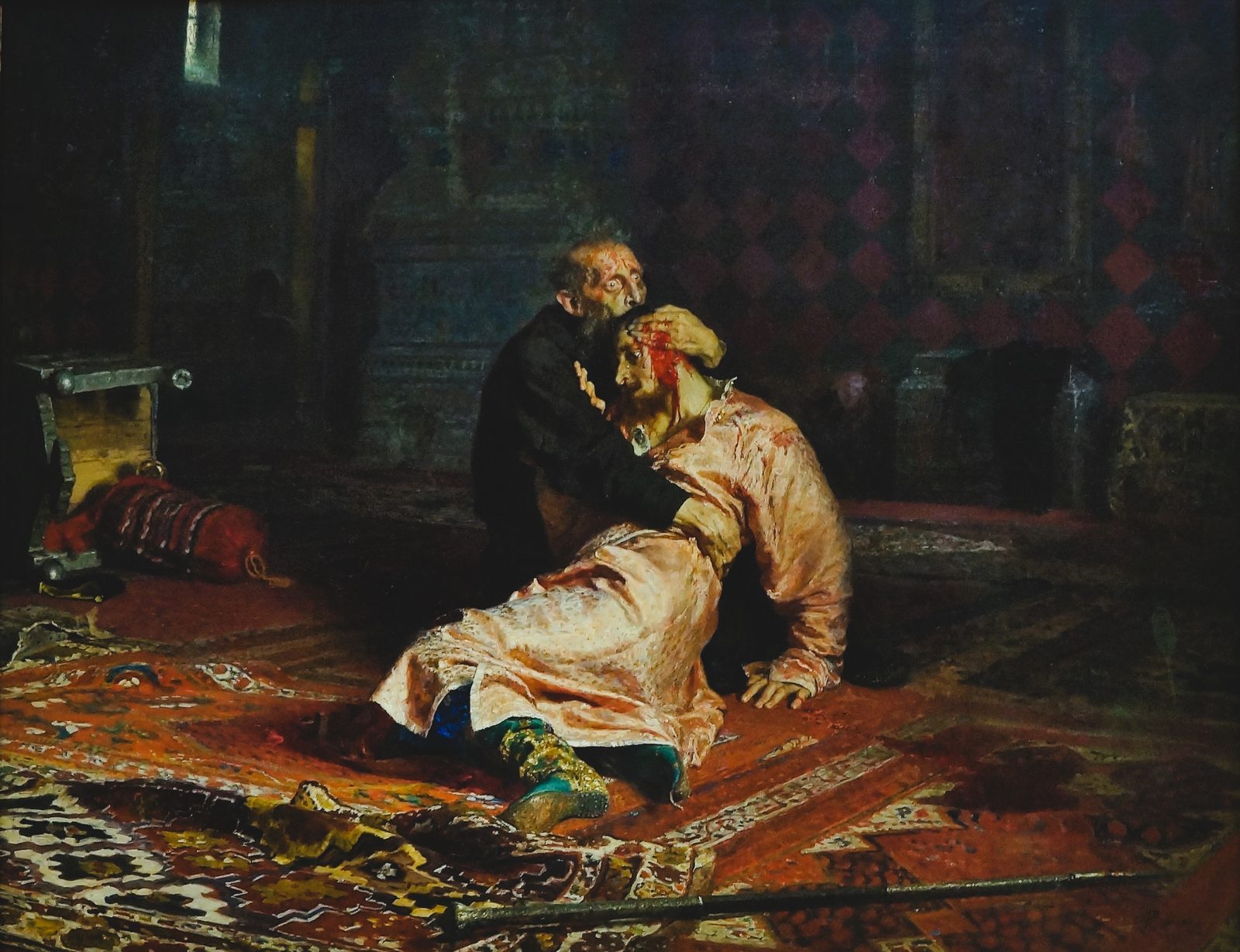
He painted not the blow but the moment after it. The tsar has dropped to the floor and pulled his son into his arms, one hand pressed hopelessly against the wound. Look at his eyes. This is a man who has just understood what he is.
For the father, Repin used his friend, the painter Grigoriy Myasoyedov. For the son, he chose the young writer Vsevolod Garshin, because he saw in Garshin's face someone condemned to perish.
The first painting Russia banned
The painting was shown in 1885, and it horrified people. Tsar Alexander III, whose own father had just been murdered, found it intolerable to watch a Russian ruler shown as a killer. On 1 April 1885 he ordered it withdrawn, making it the first painting ever censored in the Russian Empire. It was released three months later.
Slashed, then smashed
On 16 January 1913, a young icon painter named Abram Balashov walked into the Tretyakov Gallery and cut the canvas three times with a knife, shouting, as reported at the time, "Enough blood! Enough murder!" Repin, then in his late sixties, came to Moscow to repaint the damaged faces himself. When the gallery's keeper, Georgy Khruslov, heard what had happened on his watch, he threw himself under a train.
In May 2018, a visitor named Igor Podporin smashed through the protective glass with a metal pole from a queue barrier and tore the canvas in three places. He first blamed the vodka he'd had in the museum café. Later he said the painting slandered the tsar. He was sentenced to two and a half years. The restoration took six years, and the painting went back on the wall in December 2024.
The curse
Which is where the legend takes over. The story goes that the painting takes something from everyone who comes close to it. Garshin, the dying son, was dead within five years: in 1888 he threw himself down the stairwell of his apartment building, aged thirty-three. The keeper Khruslov died under a train. And Repin, the story adds, soon began to lose the use of his painting hand, and in his later years taught himself to paint with his left.
History calls these coincidences. Stand in front of the painting long enough, with that old man's eyes on you, and see if you agree.
Was it even murder?
One last twist. When the royal tombs in the Kremlin were opened in 1963, scientists found startling levels of mercury and arsenic in the remains of both the tsar and his son. Some historians now argue that the heir was poisoned, not bludgeoned. Others point out that mercury was a common medicine of the time. The painting doesn't care either way. It has already decided what happened.