The painter of real things
Maruyama Ōkyo (1733–1795) was the most admired painter in eighteenth-century Kyoto, and the founder of a whole school of painting. His gift was realism. He sketched from life, studied Western perspective, and painted puppies, carp and snow so convincingly that people said his birds might fly off the silk. It is the last quality you would expect from the man who gave Japan its ghosts.
Oyuki
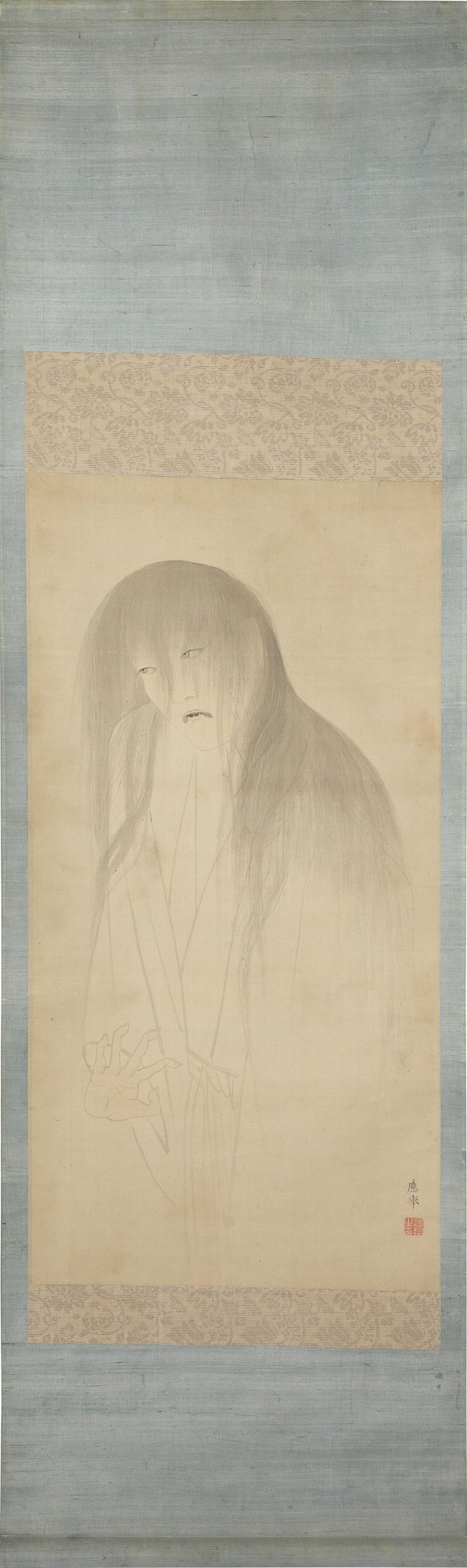
According to the story, Ōkyo loved a geisha named Oyuki, of the Tominaga house in Ōtsu, near Kyoto. She was famous for her beauty, and she died young and suddenly. Some time afterwards she came to him in a dream. He could not get the image out of his head, so he did what a painter does: he painted it.
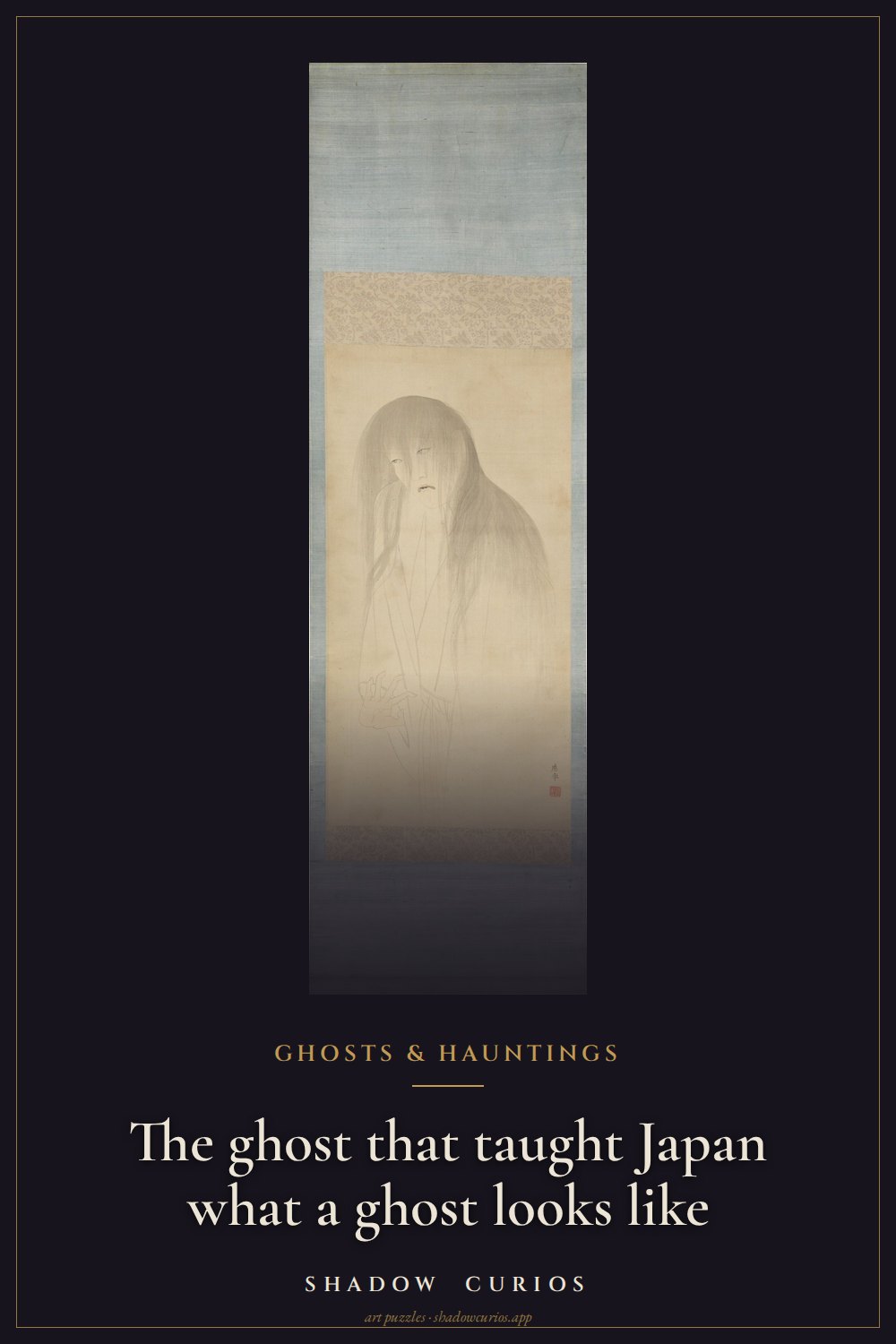
She is barely there. Her face is white, her mouth drawn down, her long black hair loose and falling forward the way it would be in death. One hand hangs limp from the wrist. And below the waist, her white robe simply thins away into the bare silk, as if she had never quite arrived.
The birth of the yūrei
Japan had ghost stories long before Ōkyo, but no one had fixed what a ghost looked like. Oyuki became that image: the unbound hair, the pale burial robe, the limp hands, and above all the missing legs. Painters copied it for two centuries, woodblock printers spread it, kabuki actors borrowed it, and the long-haired, white-robed ghost crawling out of the well in the Ring films is her direct descendant.
Too real
Ōkyo's reputation for painting from life worked against him here. People took Oyuki as a true likeness of a real apparition, a portrait of the dead drawn from observation. One story tells of a later ghost he painted that was so lifelike it peeled itself off the paper and drifted away.
More than one Oyuki
Ōkyo seems to have painted his ghost more than once, and she has been copied endlessly. The best-known version comes from a collection at the University of California, Berkeley, and is currently on loan to the Spencer Museum of Art in Kansas. The scroll shown here is another, signed and sealed by Ōkyo, which was sold at Bonhams in London in 2015. Its old storage box calls it, simply, a scroll of a devil-woman.