The lost expedition
In May 1845, Sir John Franklin sailed from England with two ships, Erebus and Terror, and 129 men, provisioned for three years. His orders were to find the Northwest Passage, the sea route over the top of North America that explorers had hunted for three centuries. The ships were last seen by whalers in Baffin Bay that summer. Then nothing.
Search after search went north and came back with fragments: graves, abandoned gear, a note left in a cairn. In 1854 the explorer John Rae brought back something worse: testimony from Inuit hunters that the last of Franklin's starving men had been driven to eat their dead. Victorian England, and Franklin's formidable widow Lady Jane, refused to believe it.
Landseer's answer
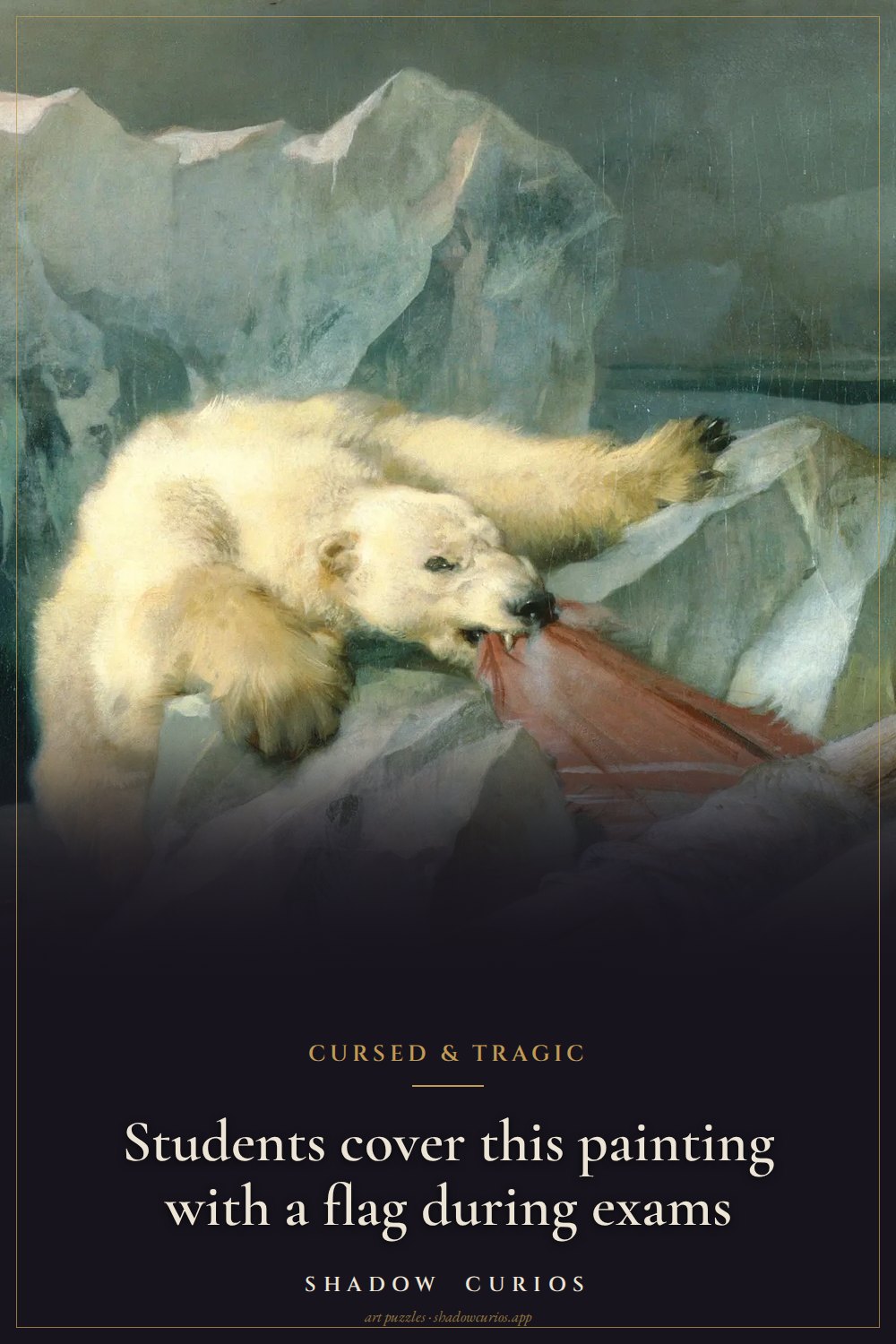
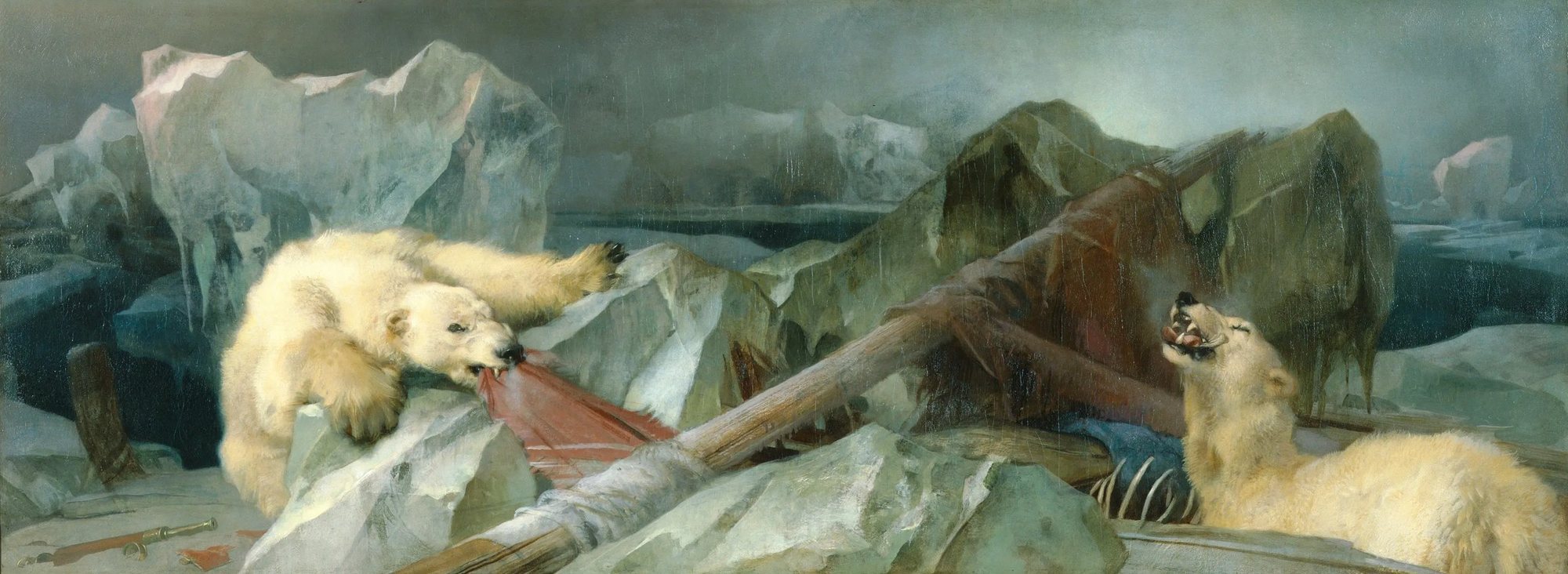
Edwin Landseer was the most loved painter in Victorian Britain, the man of noble stags and faithful dogs, the favourite of Queen Victoria. In 1864 he showed the Royal Academy something no one expected from him. Under a leaden sky, among the broken ice, two polar bears have found what is left of an expedition. One tears at a red ensign. The other has its jaws among a human ribcage, beside a snapped mast. The title comes from the old proverb: man proposes, God disposes.
There are no heroes in it, no rescue, no noble last stand. Just the ice, and the animals, and the bones. Visitors found it almost unbearable. Landseer himself, already troubled by depression, would suffer a breakdown in his last years and die in 1873.
A painting in the exam hall
In 1881 the patent medicine millionaire Thomas Holloway bought the painting at auction for £6,615, a record price at auction at the time, and hung it in the picture gallery of the college he was building for women: Royal Holloway, now part of the University of London. And in time, the picture gallery became an examination hall.
The curse
Royal Holloway students came to believe that anyone who sat an exam facing the bears would fail, or worse. Darker versions of the story tell of a student who stared at the painting through an entire exam and was later found dead, having left a note blaming the bears. No record of it has ever been found. But the college takes no chances: during exams, the painting is draped with a Union flag, and the bears watch nobody.
The ships come back
Franklin's ships stayed lost for more than a century and a half. In 2014, Canadian searchers found the wreck of Erebus on the floor of the Queen Maud Gulf. Terror was found two years later, astonishingly intact, lying in the waters of Terror Bay. Landseer's bears are still waiting on the ice.