A poem written from beyond the grave
In 1877 a slim book of verse appeared in Italy called Postuma, the poems of a young man named Lorenzo Stecchetti who had, the preface explained, recently died of consumption. Readers were enthralled. The book was a sensation, and a hoax: Stecchetti never existed. The poems were the work of a very much alive librarian from Bologna, Olindo Guerrini.
The most notorious of them is Il canto dell'odio, "The Song of Hate." It opens with three words, Quando tu dormirai, "When you are sleeping," and the sleep it means is the grave. The speaker is a man who loved a woman who laughed at him and gave herself to everyone else. Now he imagines her dead and rotting, and promises to come for her: to open her tomb, to haunt her, to make sure that even in death she cannot escape him.
The painting
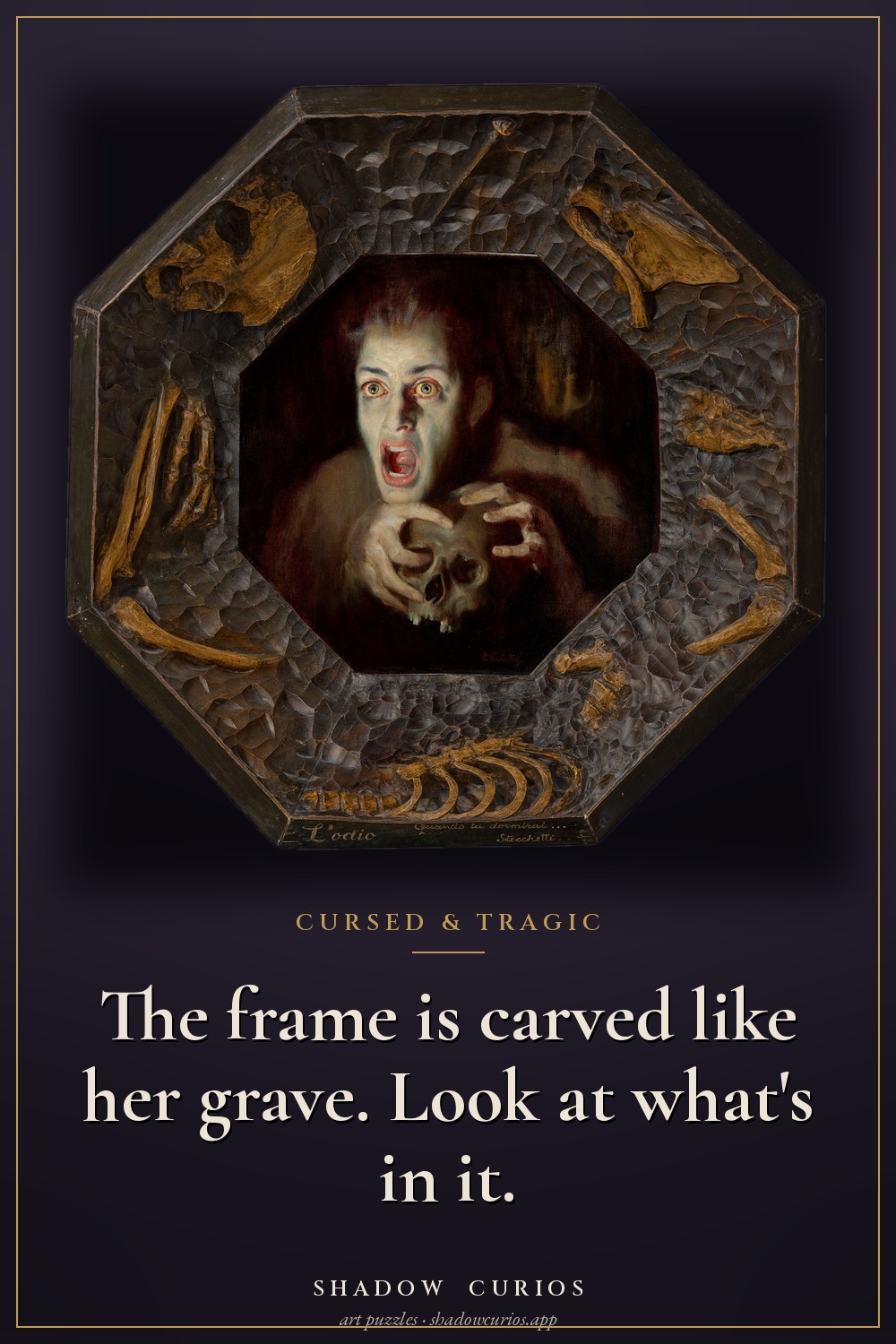
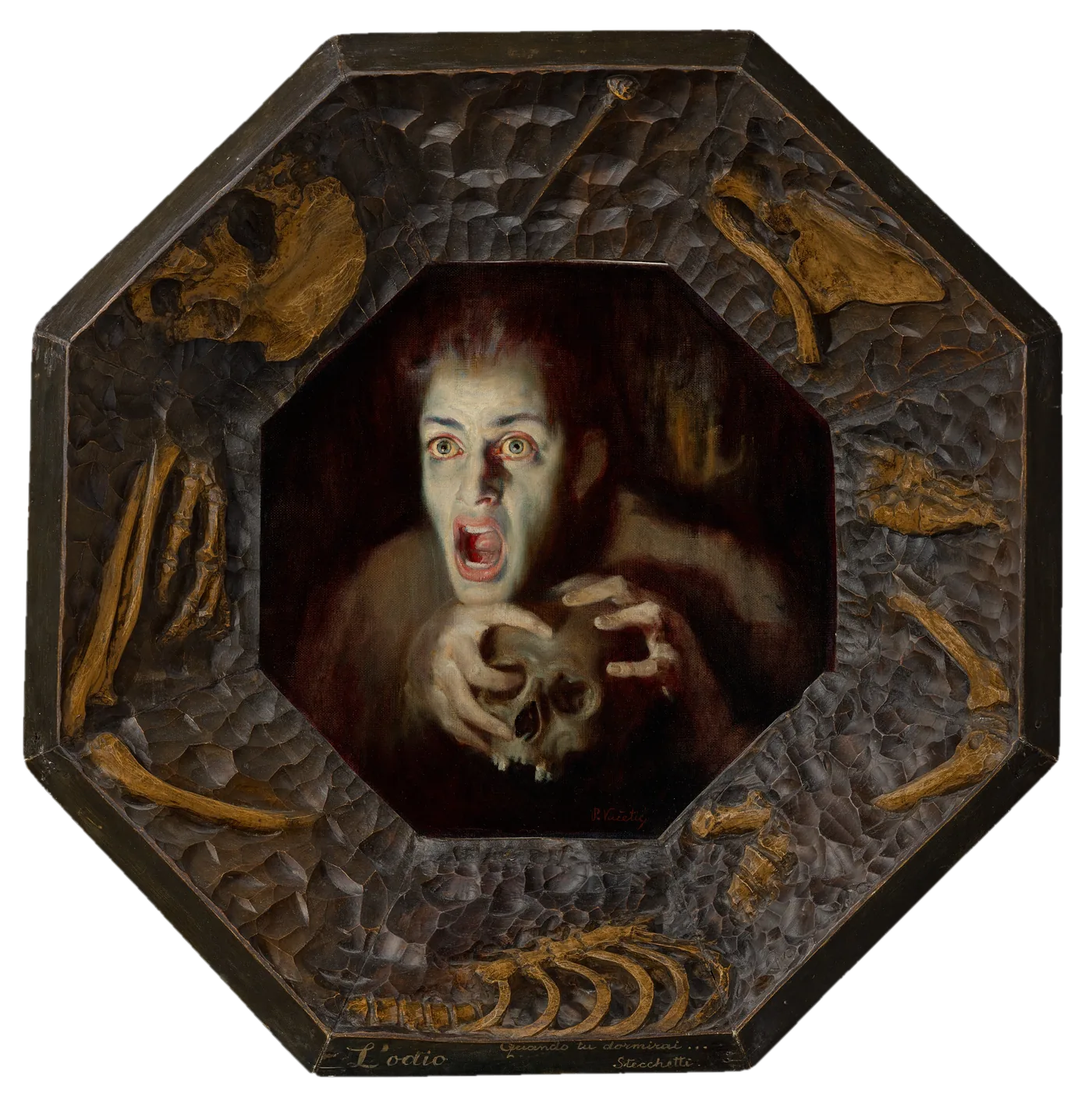
Around 1898, a young painter from Split named Paško Vučetić, fresh from the art academies of Venice and Munich, gave that man a face. It is not a face you forget. He is dead white, eyes blown wide, mouth torn open in a scream, and his fingers are hooked into the eye sockets of a skull he holds up to his chin. It is her skull. He has kept his promise.
The work is titled L'odio, Hatred, and the poem's first words are inscribed on the frame beneath him. At the Paris World's Fair of 1900 it was listed as La Haine et la folie: Hatred and Madness.
The frame is the grave
What makes the work unforgettable is the frame, carved by Viktor Kovačić, a young architect who would go on to become a pioneer of modern architecture in Zagreb. Kovačić did not make a frame so much as a hole in the ground. The walnut is gouged and chiselled to look like freshly turned earth, sinking steeply inward toward the canvas, so that the screaming man seems to be crouched at the bottom of an open grave.
Look closer
Scattered in the carved earth, stained the yellow of old bone, are the pieces of her: a ribcage along the bottom edge, a pelvis, the long bones of an arm, a hand with its fingers still curled. According to a study of the frame, Kovačić also carved her faithless heart among the remains, and maggots crawling over the bones.
Lost, then found
After Paris, the work passed quietly through private collections in Rome, Florence and Vienna, and dropped out of sight. It resurfaced at Sotheby's in London in 2012, still in Kovačić's original frame, and was later lent to the Art Institute of Chicago. It is still one of the least-known masterpieces of the macabre. Now that you have seen it, you will find it hard to forget.