A trade in grief
The American Civil War killed more than six hundred thousand men, and left their families desperate for one more glimpse of them. Spiritualism, the belief that the living could speak with the dead, swept the country. In Boston in the early 1860s an engraver named William Mumler found he could give grieving families something better than a message: a photograph, with their dead standing faintly behind them.
On trial
Mumler moved to New York, and in 1869 he was arrested for fraud. The trial was a sensation. The showman P. T. Barnum, who knew a humbug when he saw one, testified against him and had a photographer make a picture of Barnum himself with the ghost of Abraham Lincoln, to prove how easily it could be done. The prosecution could not show how Mumler did it, though, and he walked free.
Mrs. Tyndall
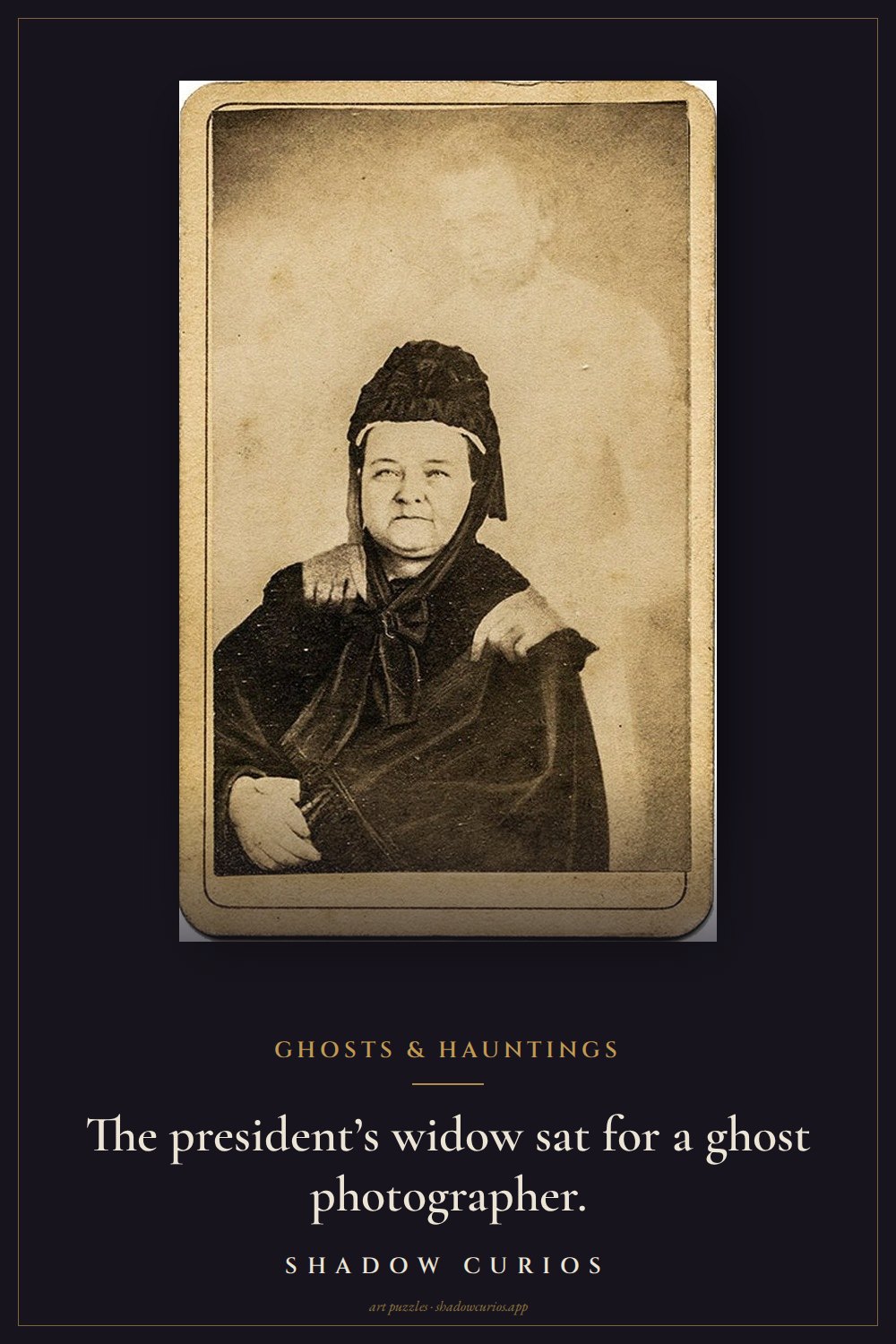
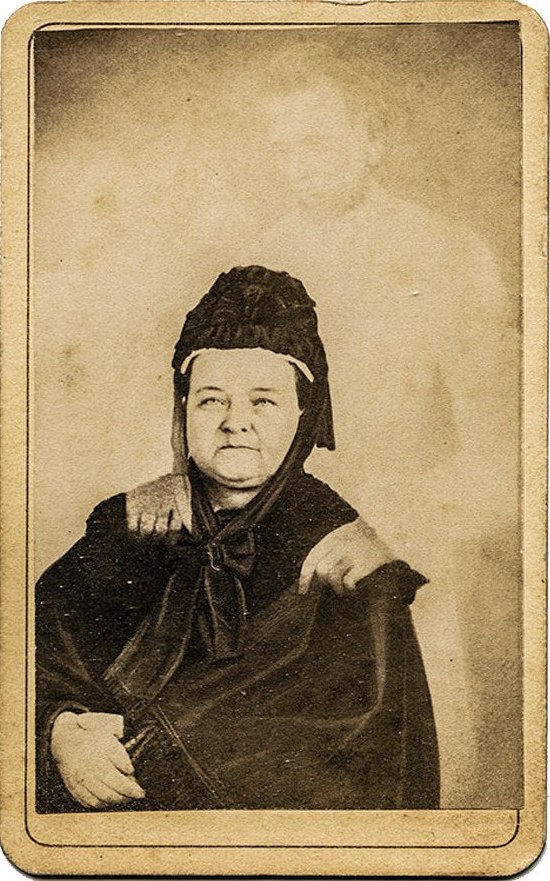
A few years later a heavily veiled woman came to his Boston studio and gave her name as Mrs. Tyndall. She was Mary Todd Lincoln, widow of the assassinated president, who had lost three of her four sons as well as her husband and had turned to spiritualism for comfort. Mumler said he did not recognise her until the picture was developed. In it, a pale, transparent Lincoln stands behind her, his hands resting on her shoulders.
Look again
Most historians assume Mumler knew exactly who she was, and that the “ghost” was a second exposure on the glass plate. But look at her face. She did not come to be fooled by a trick. She came because she wanted to see him, and here, for a moment, she does.
A ghost of an image
This is the only photograph in our collection of legends, and it is here for the story, not as a puzzle: it was printed on a card about the size of a playing card, and time has faded it almost as much as the ghost. It remains the most famous spirit photograph ever made.