The rising star
In 1842 Richard Dadd was one of the most promising young painters in London. He was twenty-five, a founder of a circle of young artists called The Clique, and already known for his fairy paintings. That summer a patron took him on a long journey through Europe and the Middle East as his draughtsman. Dadd came home changed. He said he was following the commands of the Egyptian god Osiris.
Cobham Park
In August 1843 Dadd persuaded his father to walk with him in Cobham Park in Kent, and there he killed him. He fled to France, attacked a stranger on the road, and was arrested. He was found insane, and he never lived outside an asylum again: more than twenty years at Bethlem, the hospital London called Bedlam, and the rest of his life at Broadmoor, where he died in 1886.
Nine years on one canvas
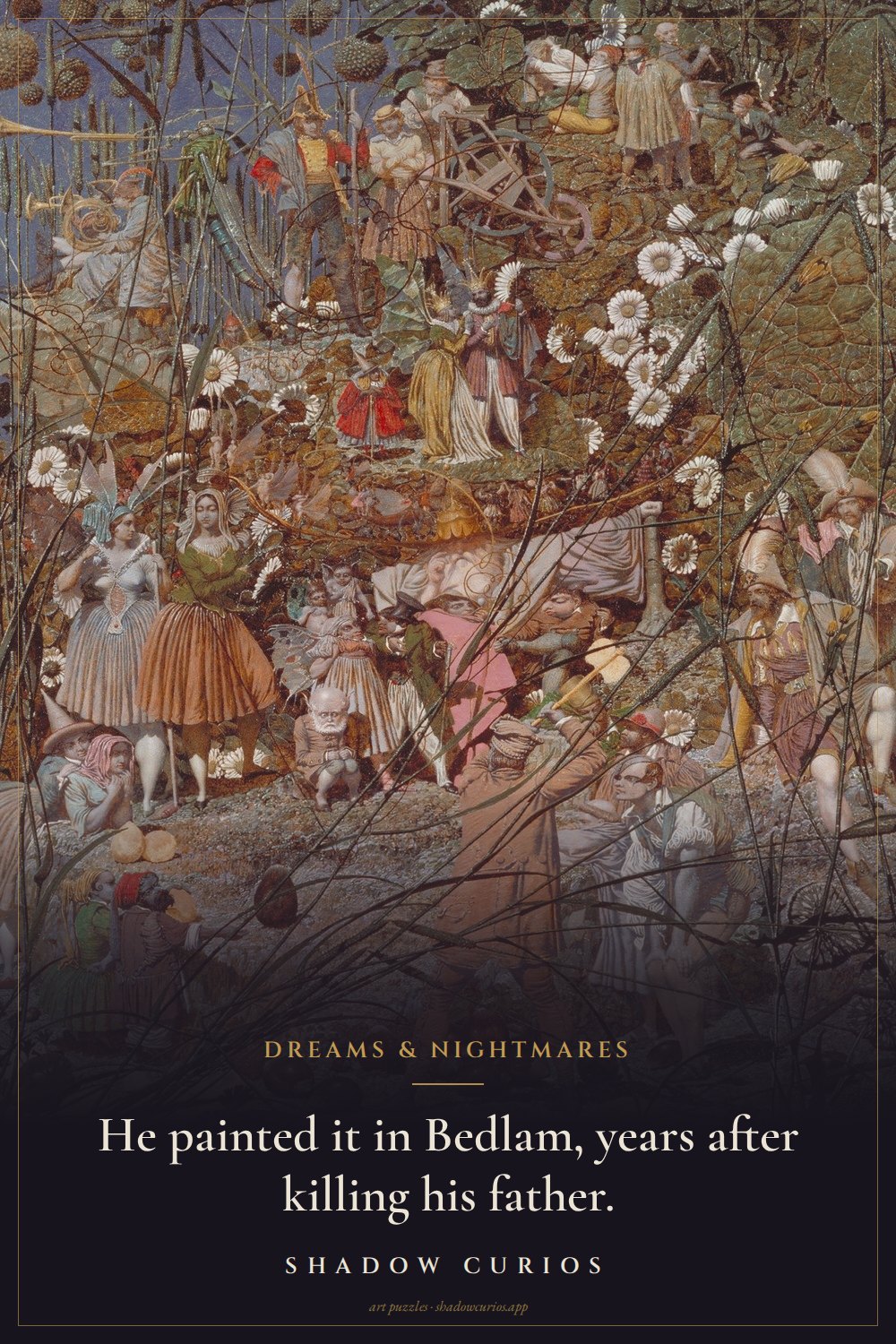
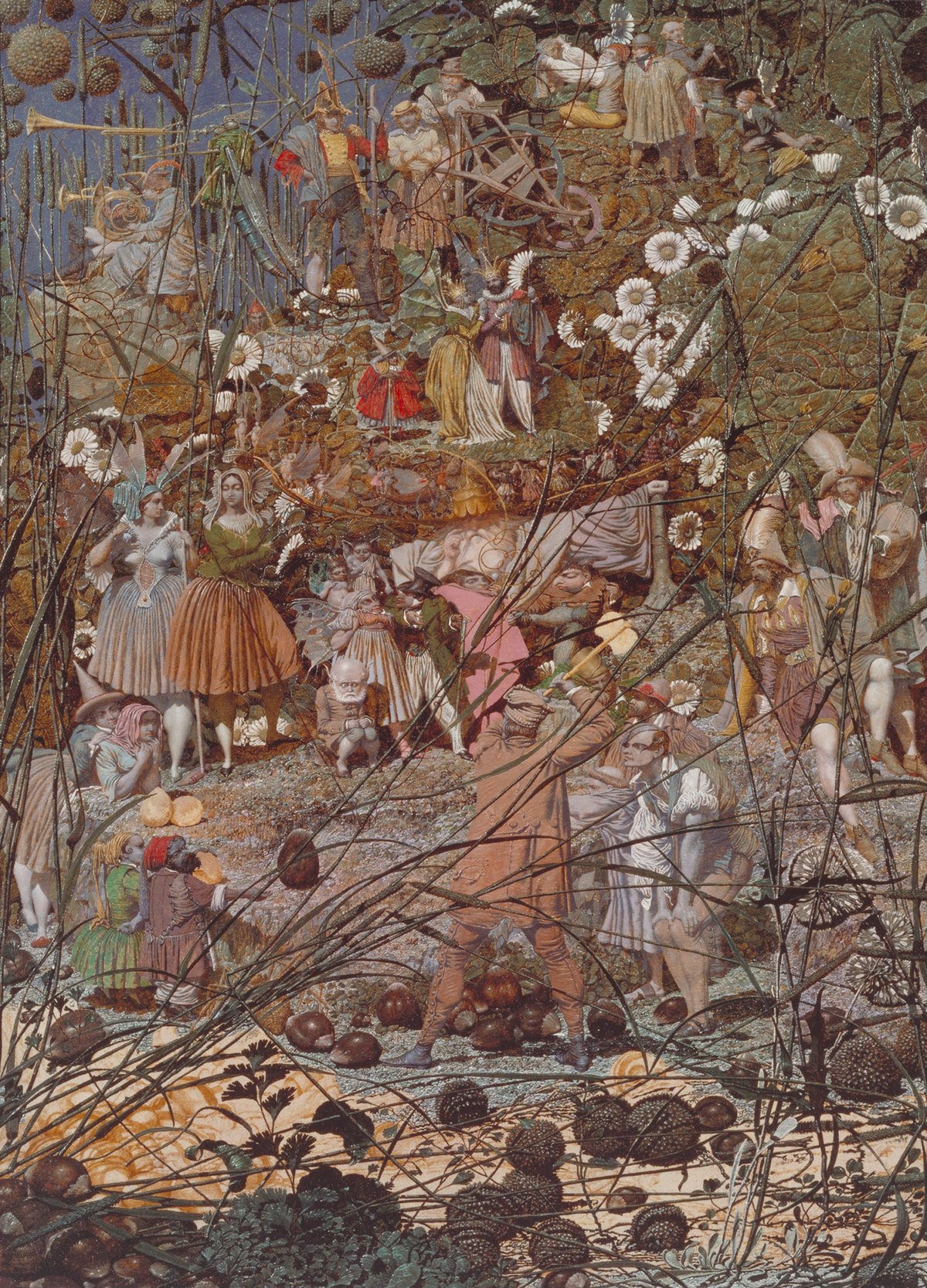
Bedlam let him paint, and he painted for the rest of his life. The Fairy Feller’s Master-Stroke was made for George Haydon, the hospital’s chief steward. Dadd worked on it from 1855 to 1864, building it up in layer on layer of tiny strokes, and when he was moved to Broadmoor he left it, by his own account, unfinished.
The canvas is barely larger than a sheet of paper. In the centre a fairy woodsman lifts his axe over a hazelnut; the old patriarch in the tall crown has to give the signal before he may strike. Around them waits a whole society: Oberon and Titania, ladies in wide skirts, a pedlar, a dwarf monk, soldiers and servants, all half-hidden behind grass stems that cut across the picture like the bars of a cage.
Explaining nothing
In 1865 Dadd wrote a long poem naming the figures in the painting one by one. It tells you who everyone is, and nothing at all about what the picture means. Whether the nut ever splits, he leaves to you.
An afterlife
The poet Siegfried Sassoon later owned the painting and gave it to the Tate in 1963. A decade after that, Freddie Mercury saw it there, and Queen named a song after it on their second album. Look closely and it is easy to see why it gets under people’s skin: every one of those tiny faces is watching, and none of them is looking at you.