The doll
The story was written down in the nineteenth century by the folklorist Alexander Afanasyev, but it is far older than that. A merchant’s wife is dying. She calls her eight-year-old daughter, Vasilisa, to her bed and gives her two things: her blessing, and a little doll. Feed the doll, she says, and tell it your troubles, and it will help you. Then she dies.
The merchant remarries, a widow with two daughters of her own, and the three of them set about working Vasilisa to death. The doll does her chores for her. She only grows more beautiful, and they hate her for it.
Sent for fire
While her father is away, the stepmother moves the household to the edge of a great forest. In that forest lives Baba Yaga, the witch who eats people. One autumn night, every fire in the house goes out, and the stepsisters push Vasilisa out of the door: go to Baba Yaga, and bring back a light.
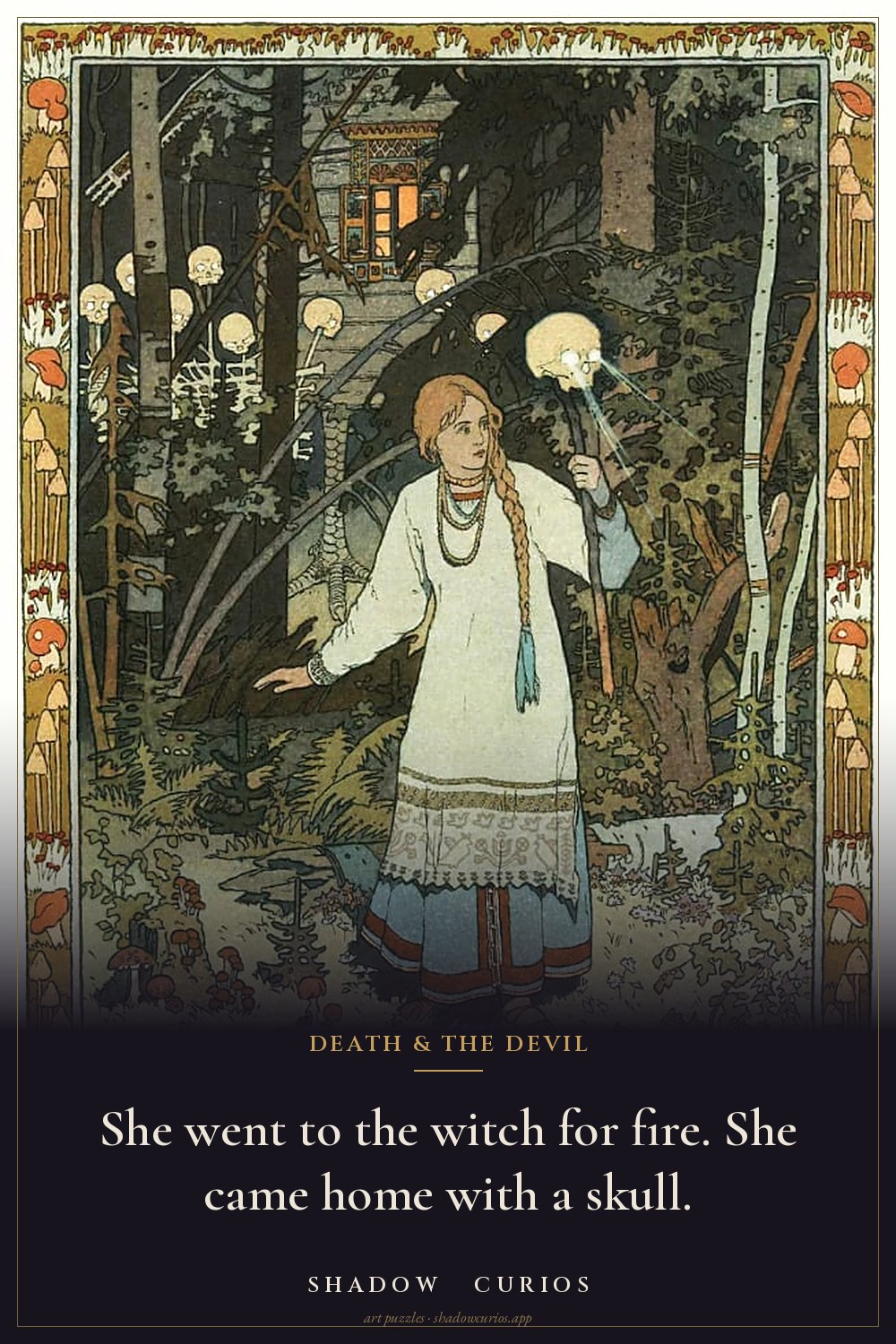
On the way, three horsemen pass her: one in white, one in red, one in black. At last she reaches the hut. The fence around it is made of human bones, and on every stake sits a skull, its empty eyes glowing in the dark. Baba Yaga comes flying home in her mortar and agrees to give her fire, if Vasilisa works for it. If the work is not done, she will be eaten.
Day, Sun and Night
Vasilisa is allowed one question, and she asks about the horsemen. The white rider, Baba Yaga tells her, is her Bright Day; the red is her Red Sun; the black is her Dark Night. When Vasilisa wants to ask about the disembodied hands that serve the witch, she stops herself. Baba Yaga approves. Not every question leads to good, she warns, and those who pry too far into her house, she eats.
The walk home
With the doll’s help, Vasilisa finishes every task. Baba Yaga, baffled, asks how. “By my mother’s blessing,” says Vasilisa, and the witch throws her out: she will have no blessed ones in her house. But she keeps her bargain. She pulls a skull from the fence, sets it on a stick, and sends the girl home with it.
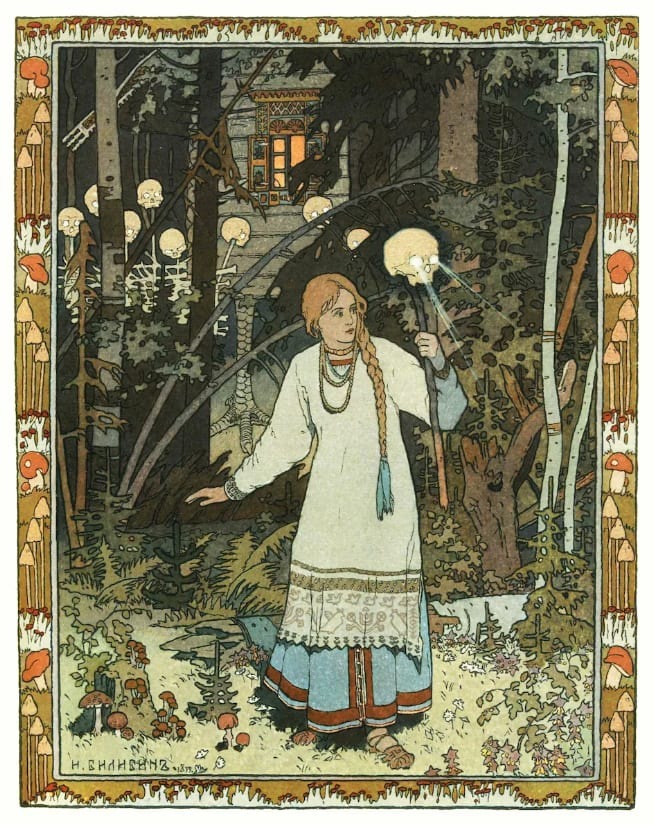
This is the moment Bilibin painted: Vasilisa walking back through the night forest, the skull held up beside her, beams of light pouring from its eyes. When she reaches home, the stepmother and her daughters crowd round the new fire. The skull’s eyes fix on them and do not look away. By morning they are ash. Vasilisa buries the skull, leaves the house, and in time weaves linen so fine that it reaches the Tsar, who marries her. She keeps the doll in her pocket for the rest of her life.
The illustrator
Ivan Bilibin was in his early twenties, and a student of Ilya Repin, when this picture made him famous. His fairy-tale plates of 1899 and 1900, printed by the state printing works in St Petersburg, with their black outlines, flat colour and ornamental borders, became the way Russians picture their own folk tales. Look closely at the border here. It is made of mushrooms, among them the red-capped fly agaric.
His own story ended darkly. Bilibin fled the Civil War in 1920, lived in Cairo, Alexandria and Paris, and in 1936 came home to Leningrad. When the Germans laid siege to the city in 1941, he refused to leave. He died of starvation on 7 February 1942 and was buried in a mass grave.