The weight
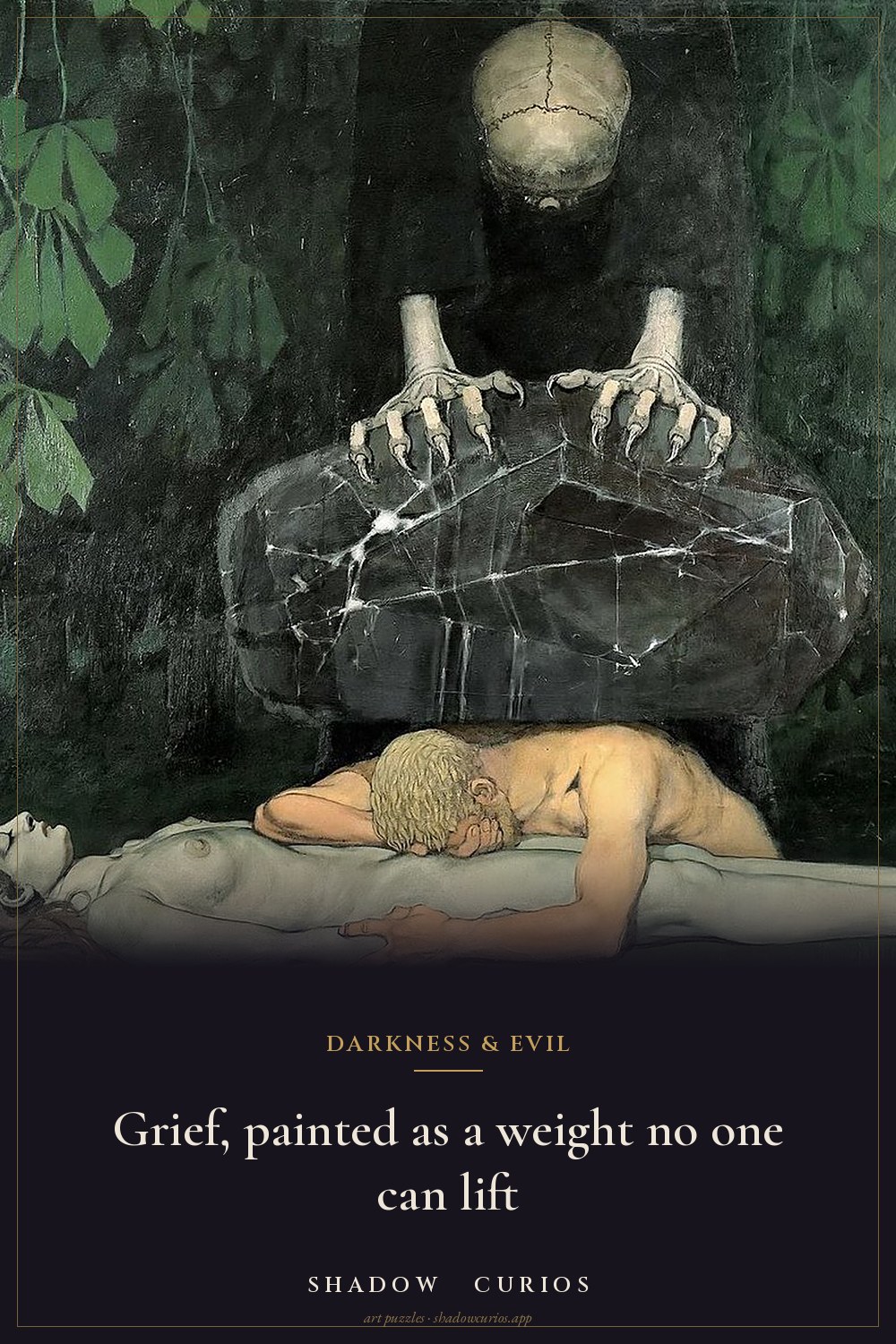
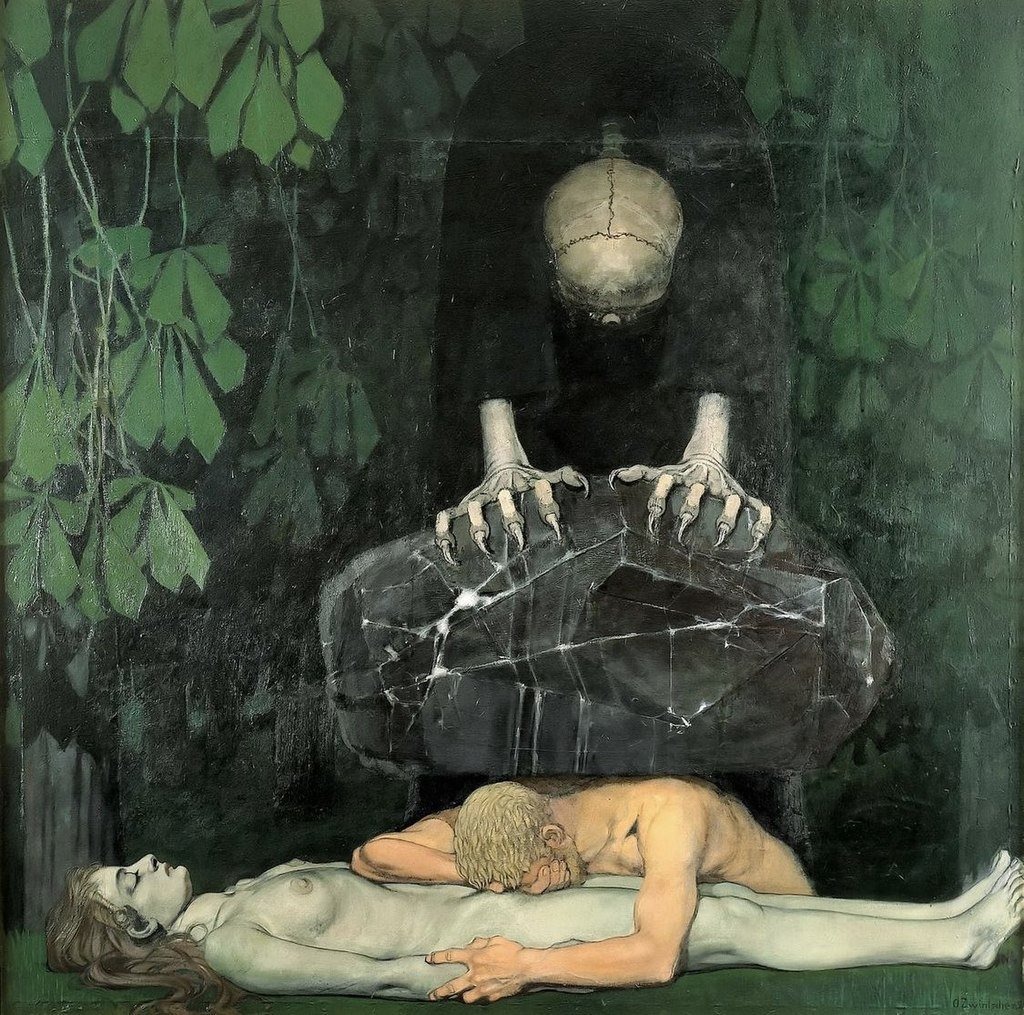
A woman lies dead on the grass, pale as stone, her hair spilling behind her. A man has thrown himself across her body, face buried, one hand still holding her. Above them sits a black stone, split with white cracks, and resting on that stone are the hands of Death: long, bony and clawed, pressing down. Death has no face to show. Its skull is bowed under a dark hood, as if it, too, were in mourning.
The German title is Gram, an old word for a grief that gnaws and will not lift. Zwintscher took it literally. Mourning in this painting is not tears. It is a weight laid on the living, and the one who lays it does not let go.
The painter in Meissen
Oskar Zwintscher was born in Leipzig in 1870 and trained at the Dresden Academy. In 1892, at twenty-two, he left the city for the small cathedral town of Meissen, a few miles down the Elbe, and stayed there for eleven years, working at a deliberate distance from the city. It was there, in 1898, that he showed his first large body of paintings to the public, Grief among them. It was also the year he married Adele Ebelt, who became his model, his steadiest supporter, and the pale, elegiac woman in picture after picture.
His work divided people. Critics either loved it or loathed it. One admirer wrote of the “fairy-tale dark, morbid glow” of his cold, metallic colour. In 1903 the Dresden Academy made him a professor.
Painter and poet
Rainer Maria Rilke admired Zwintscher. In 1902 he invited him to the artists’ colony at Worpswede to paint his wife, the sculptor Clara Westhoff, and Zwintscher painted the poet as well. Of one of Zwintscher’s self-portraits, Rilke wrote that it was “the dearest thing I have seen from you so far.”
Forgotten
Zwintscher died in 1916 at Loschwitz, outside Dresden, aged forty-five, in the middle of the First World War. Fame did not outlast him. Outside a small circle in Saxony, his name all but vanished, and for a century he waited for anyone to look again.
It took until 2022. That year Dresden’s Albertinum, after two years of technical study of his canvases, mounted a major exhibition that set him beside Böcklin, Hodler and Klimt. Museum Wiesbaden followed in 2023, and German critics began calling him “the Saxon Klimt.”